
Property Risk Analytics
Climate Risk. Hazard Exposure. Financial Vulnerability.
Understand Property Risk from Every Angle
Property Risk Analytics provides a comprehensive, AI-ready view of risk by bringing together climate, environmental, and financial indicators at the property level. By combining forward-looking climate projections, natural hazard indices, and mortgage performance data, these datasets help organizations better understand exposure, resilience, and potential loss.
Part of ATTOM’s AI-Powered Intelligence platform, this data is designed to support advanced analytics, modeling, and machine learning. It enables more accurate underwriting, stronger portfolio monitoring, and predictive insights that help anticipate risk over time.
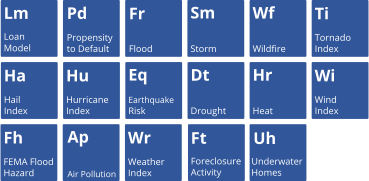
Comprehensive Property Risk Data Coverage
Access data spanning climate risk, hazard exposure, and financial distress indicators, all structured and standardized to support analytics, modeling, and automated decision-making at scale.

Loan Model
ATTOM’s logic determines the loan position when a borrower has multiple active loans on a property.

Propensity to Default
Combines historical real estate data with AI-powered analytics to help identify properties that are at risk of going into foreclosure.

Flood Risk
Properties are rated based on the risk of flooding, including the risk of inland and coastal flooding with pluvial, fluvial, high tide, and the rise in sea level.

Storm Risk
Storm risk data is based on specific precipitation risk of a property. This includes the historic number of annual extreme precipitation events with volumes, the projected number of events, and the historic and projected number of inches of extreme precipitation events per year.

Wildfire Risk
ATTOM’s wildfire risk rating provides a narrative on the burn history of surrounding land and the projected acreage of at-risk nearby land.


Tornado Index
Modeled using publicly available USGS tornado records dating back to 1950, and comprising of over 65,000 tornadoes. Spatial analysis is performed using tornado paths and single touchdown points to present a risk index. These datasets present the relative risk of a tornado at the block group level and above.


Hail Index
Presents the relative risk of a hailstorm at the block group level and above, using spatial data analysis and models that reconstruct past hail events.

Hurricane Index
Modeled using publicly available USGS hurricane records dating as far back as 1851, along with wind speed, barometric pressure, and historic hurricane spatial analysis. This data presents the relative risk of a hurricane at the block group level and above.

Earthquake Risk
Data is based on catalogs of past and recent earthquakes and the research and models from government, academia, and industry. This data considers where future earthquakes might occur, and presents a relative risk of damaging earthquakes at the block group level and above.

Underwater Homes
Identifies properties with mortgage balances exceeding current market value, offering insight into negative equity exposure at the state, metro, county, and zip code levels.


Foreclosure Activity
Provides a detailed count of properties with at least one foreclosure filing (NOD, LIS, NTS, NFS & REO) during a given month, quarter or year-to-date period.

Drought
ATTOM’s drought risk rating includes the historic and projected water stress percentage for a property, comparing water supply to demand.

Heat
ATTOM’s heat risk rating provides historic numbers surrounding extremely hot days per year, the projected number of extremely hot days per year, and the temperature threshold defining an extremely hot day

Wind Index
Modeled using historic events with wind speeds excee ding 50 mph, dating back to 1955. Presents the relative risk of damaging winds at the block group level and above.

Weather Index
Presents a unified risk index based on the relative risk of hail, hurricane, tornado, and wind at the block group level and above.

FEMA Flood Hazard
Sourced from FEMA and allow communities to understand their flood hazards and flood zones to form a basis for effective floodplain management.

Air Pollution
Offers five different air pollution risk indices: Ozone, Carbon Monoxide, Particulate Matter, Lead, and Nitrogen Dioxide. This data offers risk indices at the block group level using historic air pollution data obtained from the EPA. Air Quality is a valuable part of decision-making for real estate buyers and investors.

How Industries Can Use Property Risk Analytics

Assess exposure to climate and natural hazards to improve underwriting, pricing, and claims forecasting.

Lenders & Financial Institutions
Incorporate risk data into underwriting and portfolio monitoring to identify potential default risk and strengthen loan performance.

Support disaster planning, risk mitigation, and community resilience efforts with insights into environmental and housing vulnerability.

Real Estate & Investment Firms
Evaluate risk-adjusted opportunities and monitor portfolio exposure across markets with greater precision.

Identify at-risk properties earlier and manage servicing strategies using default and foreclosure indicators.

Integrate property risk data into applications and models to power analytics, automation, and AI-driven insights.
FAQs
What is Property Risk Analytics?
Property Risk Analytics brings together climate, hazard, and financial data to provide a complete view of risk at the property level.
How is this data used in analytics and modeling?
Property Risk Analytics is designed to support a wide range of analytical applications, including risk prediction, underwriting models, portfolio monitoring, and machine learning.
What types of risk are included?
The dataset includes climate risks such as flood, wildfire, and heat, natural hazards like hurricane and earthquake, and financial indicators including default risk and foreclosure activity.
How is this data delivered?
Data is available via API, bulk delivery, or cloud platforms, allowing it to integrate easily into existing systems and workflows.
ATTOM’s Data is Your Business Advantage

Comprehensive
A multi-sourced, enhanced national warehouse that contains information on more than 160+ million U.S. properties including:
- 70+ Billion Rows of Data
- 9,000 Data Fields
- 30TB Warehouse
- 99% Population Coverage
Flexible
Access ATTOM through a variety of flexible solutions to consume the most efficient real estate data for your specific business needs including:
Quality Data
Our rigorous Enterprise Data Management Program (EDMP) involves more than 20 steps that validate, standardize and enhance the real estate data we collect:
- Property Address Standardization
- Owner Name Parsing
- ATTOM ID Matching
- Fusion of Multi-Sourced Data
- Data Governance
Learn more about ATTOM and view our Table of Data Elements.