
Foreclosure Data
Default. Auction. Foreclosure.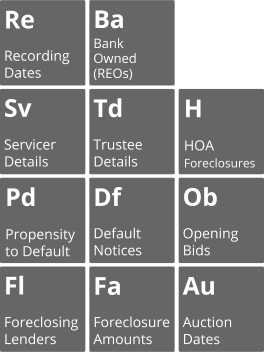
The Most Comprehensive Foreclosure Data in the Industry
With our team of local data collectors, ATTOM provides your business with complete and up-to-date nationwide pre-foreclosure and foreclosure records and details— the largest footprint available from any property data provider. From default notices, such as – Notice of Default (NODs) and Lis Pendens (LIS) – to both types of public foreclosure auctions – Notice of Trustee’s Sale (NTS) and Notice of Foreclosure Sale (NFS) – and bank real estate owned completed foreclosures (REOs) and more.
Delivering the Most Complete Foreclosure Data
ATTOM’s collection of foreclosure data is second to none in both judicial and non-judicial jurisdictions. With detailed data on foreclosure amounts, auctions dates, opening bids, foreclosing lenders and servicer details, you will have the most comprehensive foreclosure data available.

HOA Foreclosures
Foreclosures that have occurred on a property due to a Homeowner Association or Condominium Association issuing a foreclosure filing for lack of payment.

Default Notices
Public notice of a borrowers default, and the initial steps in the foreclosure process. Most commonly recorded as a Notice of Default in non-judicial states, or Lis Pendens (Latin: Pending suit) in judicial states.

Recording Dates
The date on which the instruments / notices are recorded and/or made public record. This includes the recording date of the notices, and date on which the foreclosure is recorded as well.

Foreclosure Amounts
The amount in which is owed on a property that needs to be recouped from the lender.


Auction Dates
The date in which a property is scheduled for public auction of a foreclosure property, due to the fact that the homeowner did not pay what was owed on the property during the default period.

Opening Bids
When a property goes into auction, the foreclosing lender sets an amount, that is to be the opening bid of the property, which is usually equivalent to the outstanding loan amount interest and other fees associated with the property.

Trustee Details
A foreclosure trustee is a neutral party that handles the foreclosure process on a property.

Foreclosing Lenders
The lender of a property that attempts to recover the amount owned on a defaulted loan.

Servicer Details
Many lenders will contract out mortgage services which will assume the responsibility for handling transactions between the loan provider and the borrower.

Bank Owned (REOs)
If a third party does not purchase the property at the public auction then it is repossessed by the foreclosing lender. These properties are called REOs and this includes property transferred to HUD / Fannie Mae / Freddie Mac, or other Government Sponsored Agencies (GSAs), Government Corporations (Ginnie Mae), or Government Backed Loans.

Propensity to Default
Combines historical real estate data with AI-powered analytics to help identify properties that are at risk of going into foreclosure.

What is foreclosure activity?
Foreclosure activity refers to properties with foreclosure filings; properties being taken back by lenders after borrowers have fallen behind on their mortgage payments. Foreclosure data typically includes information on default notices, public foreclosure auctions, bank real estate owned completed foreclosures (also known as REOs), and more.
Have Questions About Foreclosure Data?
How Can You Use ATTOM’s Foreclosure Data?

Real Estate Portals
Real estate portals can use our foreclosure data to display the most recent foreclosure properties as a way to increase user engagement and drive more leads to their agents.
Learn More

Mortgage Origination
Pre-foreclosure and foreclosure data arms mortgage originators with information to supplement credit data and more accurately assess risk when underwriting loans.
Learn More

Insurance
Properties currently or previously in foreclosure pose a risk for insurance companies because foreclosure properties often incur damage during the foreclosure process.
Learn More

Direct Marketing
Investors, real estate agents, attorneys and credit repair companies are always looking for direct marketing lists of pre-foreclosures for their businesses.
Learn More

Government
Government agencies use foreclosure data to see trends and assess macro market risk of foreclosures in an area.
Learn More

Institutional Investors
Create custom reports and identify foreclosure activity for internal analytics and investment opportunities.
Navigating the Future of the Distressed Market
Listen in as industry experts share timely insights and data-driven analysis on the shifting dynamics of today’s distressed housing market. With affordability challenges, elevated rates, and rising delinquency signals, the distressed market is once again in focus. This session will offer insights for lenders, investors, servicers, and housing professionals looking to stay ahead of risk and uncover opportunity.

High-level insight includes:
- Economic & Housing Trends
- Distressed Market Insight
- Supply & Demand
- Opportunities Available
- Foreclosure Forecast
- Data Products Available for Distressed Market Insight
- How ATTOM’s Propensity to Default model helps spot risk before it hits public records
- Market signals to watch as we head into 2026
- And more….
ATTOM’s Foreclosure Insights



Top 10 Counties Foreclosure Data
ATTOM’s Data is Your Business Advantage

Comprehensive
A multi-sourced, enhanced national warehouse that contains information on more than 158 million U.S. properties including:
- 70+ Billion Rows of Data
- 9,000 Data Fields
- 30TB Warehouse
- 99% Population Coverage
Flexible
Access ATTOM through a variety of flexible solutions to consume the most efficient real estate data for your specific business needs including:
Quality Data
- Property Address Standardization
- Owner Name Parsing
- ATTOM ID Matching
- Fusion of Multi-Sourced Data
- Data Governance
Learn more about ATTOM and view our Table of Data Elements.