
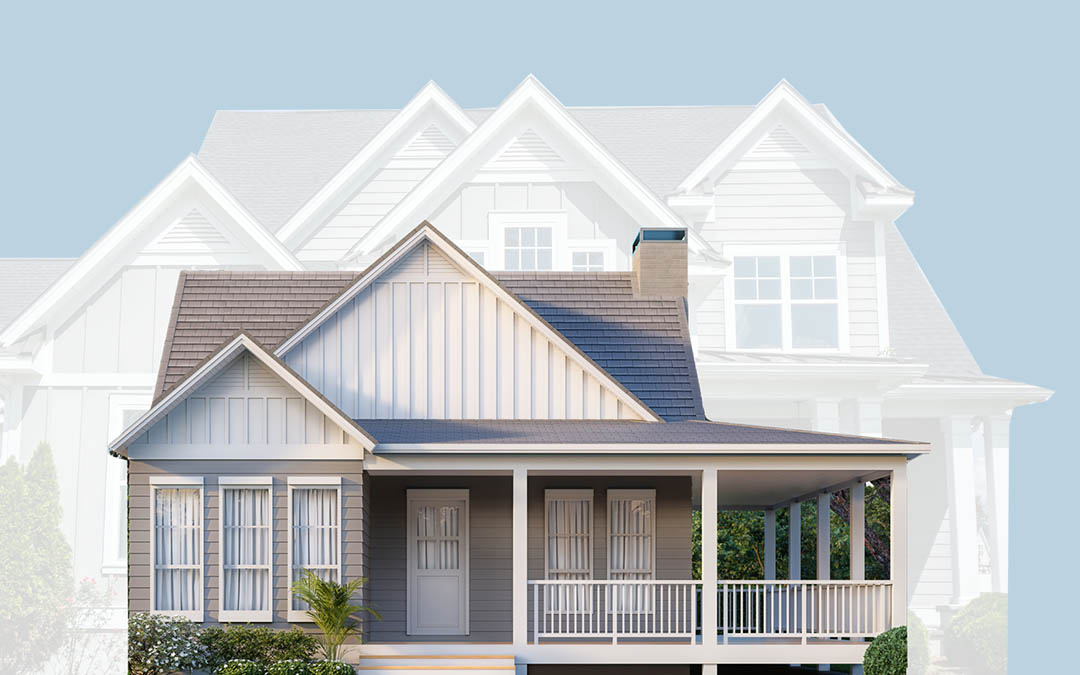

A new trend is emerging in real estate. The mammoth single-family home on a quarter-acre lot is giving way to something more modest: a smaller home for smaller households, stretched budgets, and fewer hassles.
“Data from the U.S. Census Bureau confirm that builders are constructing smaller homes,” noted the National Association of Home Builders (NAHB) in April. “The median home size dropped from 2,200 square feet in 2023 to 2,150 square feet in 2024 — the lowest in 15 years.”
“The median home size peaked in 2015 at 2,467 square feet and has slowly declined each year since,” said The Zebra insurance site last year.
It’s not just that homes are getting smaller; the same is true with lots.
According to the Census Bureau, 45% of the completed homes in 2024 had lots that were 7,000 sq, ft, or less. That compares with 33% in 2014. Meanwhile, the market for larger lots has shrunk. In 2024, 7% of the completed homes had lots with 9,000 to 10,000 sq. ft. Ten years earlier, such lots represented a robust 12% of the market.
The shift to smaller homes is not a retreat from luxury and habitability. We’re not talking about going back to medieval hovels with dirt floors and thatched roofs. Instead, the new trend toward smaller homes is largely a byproduct of changing demographics, rising costs, and a growing interest in practical living – a preference that has even begun to attract an increasing number of millionaires.
Are Smaller Homes Really Smaller?
We routinely think of homes in terms of overall square footage, but an alternative measure is to consider how many square feet are available per resident.
According to the Census Bureau, the floor area of a completed single-family home averaged 1,660 square feet in 1973. The average was more than 1,000 sq. ft. higher in 2016 at 2,687 square feet.
So yes, it’s nice to have a larger home, but is that what we need or can afford? The typical household had 3.06 people in 1973. That figure has shrunk over time. The typical 2016 household had just 2.53 people.
In other words, the average new home in 1973 provided 542 sq. ft. per person (1,660 sq. ft. divided by 3.06). That figure almost doubled to 1,062 sq. ft. per person in 2016 (2,687 sq. ft. divided by 2.53).
The result of changing demographics is that we can now rethink home sizes. A bigger house is not necessarily an advantage if additional square footage simply means more vacant, dust-gathering space. Excess space is largely an expense, square footage that costs money to buy, finance, heat, and cool. It raises property taxes and becomes indoor acreage that someone has to clean and maintain.
New Uses For Old Spaces
In the same way that household sizes are changing, that’s also the case with residential real estate and its utility. A home is no longer just a residence. Today, millions of homes are also solar collection centers, electric power stations for cars, and home offices. It’s estimated that more than five million homes have solar panels, 35% of us do some or all of our work from home, and well over 25 million residences are expected to have home charging ports for cars by 2030.
The introduction of these new functions adds value and convenience, yet homeowners can benefit from them without requiring extra space. Solar panels are typically located on rooftops. Home offices are often no more than a laptop that can be located anywhere. And — with the help of an electrician — a dryer outlet can be used to recharge electric vehicles, creating an at-home fueling station.
Conspicuous Consumption Versus Small and Less Stress
Every town has its big house, that mansion on the hill, or a massive estate built long ago by someone who wanted to impress the family, neighbors, business associates, or just folks walking by. Such properties are examples of “conspicuous consumption,” spending designed to confirm one’s social status without being especially practical or maybe practical at all.
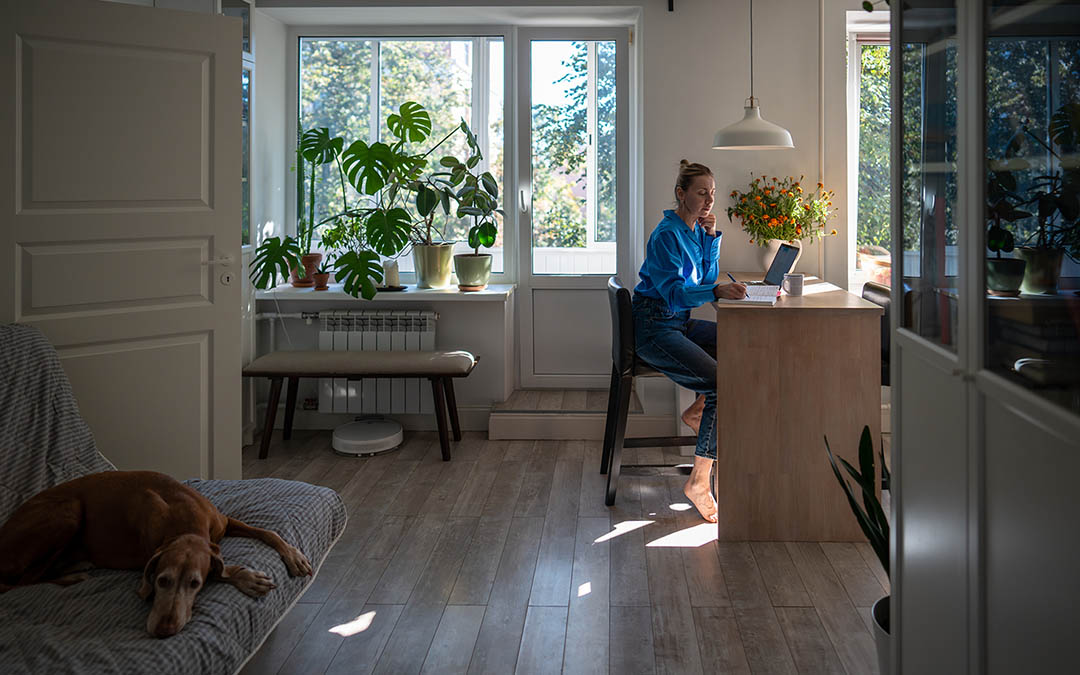
Many of us have moved away from such thinking. Part of the reason is that giant homes require people to maintain them. As Voltaire reminded us, “The comfort of the rich depends upon an abundant supply of the poor.” There just aren’t many individuals who want such work, and even when staffing is available, they require owner time and supervision. Effectively, owners wind up in the “home administration” business.
Many affluent owners don’t want the complications, lack of privacy, or the costs of big-house living. The result is that many elect to live modestly.
Consider Warren Buffett, one of the richest people in the world. As of mid-July, his fortune was valued at more than $140 billion, according to Forbes. And yet the Omaha resident famously lives in a home bought for $31,500 in 1958, eats breakfast at McDonald’s, and drives older cars.
In The Millionaire Next Door, a book first published in 1996, authors Thomas J. Stanley and William D. Danko found that “Twenty years ago we began studying how people become wealthy. Initially, we did it just as you might imagine, by surveying people in so-called upscale neighborhoods across the country. In time, we discovered something odd. Many people who live in expensive homes and drive luxury cars do not actually have much wealth. Then, we discovered something even odder: Many people who have a great deal of wealth do not even live in upscale neighborhoods.”
UBS, a major Swiss bank, said in its most recent Global Wealth Report that the US had added 379,000 millionaires in 2024. That’s more than 1,000 per day, but with modest living, such individuals are often difficult to find.
“Wealth,” said UBS, “is far less uniform and a lot harder to spot than income, for it is only visible when it translates into consumption. Status symbols are a testament to the hidden nature of wealth: they have been invented specifically to show off wealth that would otherwise go unnoticed.”
Or, as George Carlin explained, “That’s all your house is: a place to keep your stuff. If you didn’t have so much stuff, you wouldn’t need a house.”
Not a big house, anyway.
Millionaires and Options
Given rising home values, it might seem as though ownership is the way to go and renting is to be avoided. Surprisingly, people with the ability to choose are sometimes opting for rentals.
We usually associate homeownership with a certain level of income and solid credit. It’s a rite of passage to buy a first home, a form of financial accomplishment and social standing. But what can we think about those with high incomes and great credit but little interest in buying a house? In particular, why would millionaires turn away from owning the place where they live?
“While still relatively small in number,” said The Wall Street Journal in September, “millionaire renters in the U.S. are on the rise, a reflection of how the calculus around homeownership has changed for even the wealthiest in the U.S.”
It added that “some would rather keep cash in the stock market and other investments, with home prices and transaction fees elevated. High borrowing rates can still be painful for those who don’t need to take out a mortgage but would prefer to for investment reasons. Banks used to offer lower mortgage rates on jumbo loans, but that has reversed over the past year. High rates are less of a factor for all-cash buyers but still keep the market locked up.”
The Affordability Hurdle
While it’s good to know that our millionaire population is increasing and that many live modestly, most of us have not reached such heights, especially those who rent. Renters had a median net worth of $10,400 in 2022. according to the Federal Reserve. Homeowners had 38 times as much, with a median net worth of $396,200. No doubt some of this owner wealth is a byproduct of real estate ownership.
The rapid increase in home values has been a boon for owners and a rising barrier for would-be buyers. Median home sales rose from $195,000 in Q2 2015 to $369,00 in Q2 2025, according to ATTOM. That’s an 89.23% increase. Meanwhile, real mean family income increased from $116,400 in 2015 to $135,700 in 2023, according to the latest available Census Bureau figures. Family income was up 16.58%.

A March 2025 study from the National Association of Home Builders found that “The nationwide median price of a new single-family home is $459,826, meaning half of all new homes sold in the U.S. cost more than this figure and half cost less. A total of 100.6 million households – roughly 75% of all U.S. households – cannot afford this median-priced new home based on a mortgage rate of 6.5%.”
The income-to-price barrier is significant. According to the National Association of Realtors, first-timers accounted for 24% of the existing home sales it tracked in 2024. That’s the lowest level of first-time activity since it began collecting data in 1981.
Why Smaller Homes Are Gaining Traction
Given this cascade of fast-rising prices and slow-moving wage increases, many people no doubt assume they will never be able to buy a first home. But what if homes didn’t cost so much?
In rough terms, if a typical home has 2,150 sq. ft. and costs $423,000, then the cost per square foot is $196.74. But what if we can work with a well-designed home that has 1,900 sq. ft.?
That’s 250 sq. ft. less, and at $196.74 per sq. ft., it means a buyer might save $49,185. At 6.5% interest, that reduces expenses for principal and interest by $311 a month. The lower price also means less is needed for the down payment, property taxes, and property insurance. A lower debt-to-income (DTI) ratio will make lenders happy.
A smaller house may well be the key to affordability for potential buyers. Combine reduced square footage with a less expensive location, down payment assistance (there are more than 2,500 programs to help buyers, according to DownPaymentResource), plus a willingness to fix up and repair over time, and suddenly homeownership may not be out of the question. Instead, a smaller house may be the first step toward equity and financial independence.