

Contents
ATTOM’s Property Data Points
ATTOM’s Data Delivery Options
ATTOM’s Bulk Data Delivery for AI Optimization
Who Needs Snowflake and Databricks?
Property Data and Delivery Options Tailored for Your Use Case
Frequently Asked Questions (FAQs)
The type and volume of property data now available can feel overwhelming. While parsing and synthesizing that data is challenging for most people, artificial intelligence (AI) systems can process, manage, and apply it with remarkable speed and efficiency.
ATTOM has one of the most extensive ranges of property-related data points among reliable providers. These datasets are being used by AI-powered tools with ever-increasing levels of sophistication.
Snowflake and Databricks are ATTOM’s latest cloud-delivery platforms. Here’s a look at how ATTOM’s vast data warehouse, combined with Snowflake and Databricks, is helping users fully capitalize on their AI systems.
ATTOM’s Property Data Points
The table below shows highlights of ATTOM’s data points covering 158 million U.S. residential and commercial properties.
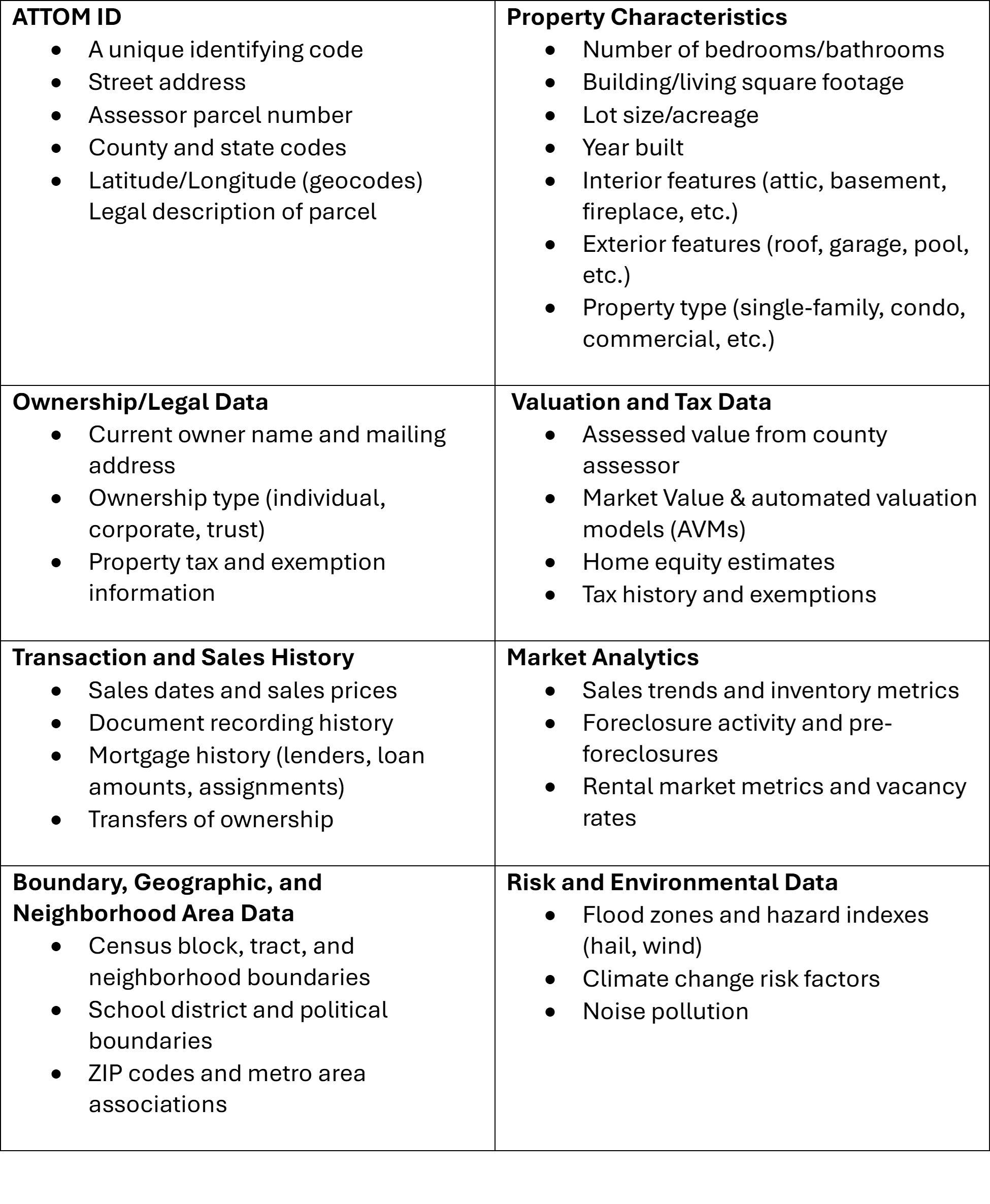 The extent of the data offered by ATTOM serves users from practically every industry: real estate, institutional investors, mortgage lenders, insurers, governments, and home service providers, to name a few.
A company will use ATTOM’s property data for different purposes:
- Real estate brokerages use the data for property valuation and market analysis
- Marketing groups use the data for prospecting and lead generation
- Mortgage and lending companies use the data for risk assessment and underwriting
- Investors use the data to identify opportunities
- The public sector uses data for tax assessment and urban planning
- Home service companies use property data to explore markets and possibilities for expansion.
Because the use cases are so varied, how ATTOM delivers data to its users is critical. Some clients often prefer specific, niche data through an API. Large institutional users might want bulk data through licensing.
Here’s a look at ATTOM’s delivery modes, including their latest cloud-based SnowFlake and Databrick options.
ATTOM’s Data Delivery Options
Applicant Programming Interface (API)
ATTOM’s Property Data API is best for real-time, targeted data queries. It’s a good option for users who don’t want to manage large files. The API also integrates well with other applications.
Bulk Data Delivery
Users who want to analyze large volumes of data and don’t have API infrastructure in place might choose bulk data delivery. They can receive the data for in-house analysis and storage.
ATTOM offers several bulk property data delivery options, ranging from traditional file transfers to cloud-based systems for AI applications. Here’s a breakdown of the main delivery methods and how they’re typically used.
Bulk Data Licensing
Bulk data licensing is ATTOM’s primary data delivery channel. Users can access data for use in their own proprietary systems. The data are often used for analytics, marketing, and delivered to customers via portals and APIs.
File-Based Bulk Delivery
File downloads are the most common way ATTOM data users receive data. FTP or SFTP transfers accommodate large datasets, and file formats are typically CSV or ASCII. Large or geospatial datasets are delivered in Parquet and GeoParquet formats. Again, these files are typically used for analytics.
Scheduled Bulk Data Feeds
Some users of ATTOM’s bulk data receive regular bulk feeds on a weekly, monthly, or quarterly basis.
These feeds are typically full files or “match-and-append” enrichment files via FTP.
Match and Append Bulk Delivery
This type of delivery matches property lists to ATTOM IDs, allowing users to append selected property attributes to their existing records. This method is often used for marketing and customer relationship management (CRM) purposes.
ATTOM’s Cloud Delivery for AI Optimization
ATTOM has recently introduced two new options via cloud delivery: Snowflake and Databricks.
These two delivery options allow users to query and access data immediately. ATTOM’s newest AI tools deliver structured data responses optimized for AI workflows, such as automated valuation models (AVMs), finding comps, and reporting sales histories.
Who Needs Snowflake and Databricks?
Any company or website that mines property data for AI applications, bots, or agents needs Snowflake or Databricks for their workflows.
Most websites these days use AI assistants or chatbots to serve visitors, or copilots and research portals to aid their staff. For example, on a realtor’s website, an AI assistant can fetch standardized property data directly from ATTOM to support research and analysis.
Underwriters at an insurance company can automate their due diligence processes, summarize documentation, and create property reports using data and cloud-based delivery.
Here’s a closer look at ATTOM’s new offerings: Databricks and Snowflake.
Databricks
Databricks is a “data lakehouse” platform optimized for big data processing using AI and machine learning (ML). Databricks handles structured, semi-structured, and unstructured data. To use Databricks, users should be proficient in proficiency in Python, Scala, or Spark.
Snowflake
Snowflake is a similar option to Databricks, but it is a better choice for SQL users and SQL-based data warehousing and analytics. Historically, Snowflake has focused more on structured/semi-structured data.
Property Data and Delivery Options Tailored for Your Use Case
ATTOM has been at the forefront of property data collection and delivery for decades. Their products and delivery methods continue to evolve based on the needs of property data users. Whether your industry is real estate, investments, fintech, government, or insurance, ATTOM has what you need to stay ahead in an AI-driven world.
Contact an ATTOM representative today to find out more about how ATTOM ‘s superior data and data delivery can make your processes faster and better.
Frequently Asked Questions (FAQs)
1. What types of property data does ATTOM provide?
ATTOM’s property data covers around 158 million residential and commercial U.S. properties. The data are extensive, including property characteristics, ownership records, valuation and tax data, sales and mortgage histories, market analytics, geographic, geospatial, and boundary data, and environmental and risk indicators such as flood zones and climate risk factors.
2. What are ATTOM’s main property data delivery options?
ATTOM delivers property data via APIs and bulk delivery options, such as file-based transfers, scheduled data feeds, match-and-append services, and data licensing. ATTOM’s newer cloud-based options — Databricks and Snowflake — allow companies to access data directly for advanced analytics and artificial intelligence applications.
3. How do Databricks and Snowflake work?
Databricks and Snowflake act as a secure bridge between ATTOM’s data and AI systems. The server enables AI tools to retrieve structured data in real time.
4. How do cloud platforms like Snowflake and Databricks enhance property data usage?
Snowflake and Databricks are data platform solutions optimized for analytics and AI. These delivery systems allow AI assistants, chatbots, and automated workflows to perform research, reporting, and analysis more efficiently.
5. Which industries benefit from ATTOM property data and delivery options?
Any industry can benefit from ATTOM’s property data. Real estate, mortgage lending, insurance, investment firms, government agencies, marketing organizations, and home service providers are examples of users. The data are used in many ways, from underwriting and risk assessment to market analysis, urban planning, and customer prospecting.
