


Rent control is a looming issue across the country. Although the concept is banned in 33 states, more than 300 jurisdictions now have some form of rental caps, a situation that raises a question: With new leadership in Washington, will the Trump Administration seek a nationwide rent control ban?
Rent control has been around for a long time. A very long time. Julius Caesar is said to have enacted such rules more than 2,000 years ago, and ever since people have debated whether rent control is good, bad or maybe something in the middle.
The present day is no exception.
Most states allow rental rates to be determined by the marketplace, while the National Apartment Association lists California, Maine, Maryland, Minnesota, New Jersey, New York, Oregon, and the District of Columbia as jurisdictions that permit various forms of rent control.
In addition, Washington just adopted a statewide rent control measure in May. The new law limits most annual rent increases to 7% plus the rate of inflation or a maximum of 10%, whichever is less. There are several exceptions, including public housing rental units and up to two accessory dwelling units (ADUs) on an owner-occupied property.
However, times are changing, and new federal actions could impact or even end rent control at the state and local levels.
Regulation vs. Deregulation
Rent control is part of the larger debate regarding regulation in general. Between 3,000 and 4,500 new rules at the federal level are enacted annually, according to the Congressional Research Service.
Regulations and what they include or exclude are a political issue, and it follows that when administrations change, so do regulatory page counts. As an example, the number of regulatory pages went from 97,000 in 2016 to 62,000 at the start of Trump’s first term in 2017.
Rent control is not federally regulated at this time; however, this can change. In 2024, for instance, the Biden Administration proposed a nationwide 5% rent cap for millions of units controlled by large landlords.
Under the plan, “corporate landlords, beginning this year and for the next two years, would only be able to take advantage of faster depreciation write-offs available to owners of rental housing if they keep annual rent increases to no more than 5% each year. This would apply to landlords with over 50 units in their portfolio, covering more than 20 million units across the country. It would include an exception for new construction and substantial renovation or rehabilitation.”
How would the nationwide rent control program be enforced? Landlords who did not go along with the program would “risk losing current valuable federal tax breaks.” In this case, according to NAIOP, a commercial real estate association, large landlords who breached the 5% annual cap would only be allowed to depreciate properties over 39 years instead of 27.5 years. The longer depreciation period would mean less to deduct each year and a bigger tax bill.
The Trump Approach
While the Biden plan would have established a nationwide rent control program, the Trump Administration is likely to move in the opposite direction.
Rent control is no mystery to Donald Trump. His father, Fred Trump, built roughly 27,000 apartment units, making him one of the largest developers in New York City. The Trumps had to navigate the City’s rent control policies, “emergency” guidelines established during World War II that included complex price controls and various tenant options opposed by most landlords.
Rent control was listed as a “regulatory barrier” In the first Trump Administration. A White House Council on Eliminating Regulatory Barriers to Affordable Housing was established in 2019 to “reduce and streamline statutory, regulatory, and administrative burdens at all levels of government that inhibit the development of affordable housing.”
While little was done regarding rent control under the first Trump Administration, that may not be the case in the second. In its first 100 days, the Trump Administration has broadly sought to end or reduce regulatory burdens. Examples include the 10-1 deregulation initiative that requires federal agencies to end 10 existing regulations for each new regulation they propose, and an Executive Order that limits the ability of state and local governments to block energy production.

How might the Trump Administration undo rent control?
“HUD,” said the American Enterprise Institute in March, “should adopt new regulations governing its major aid programs – from community block grants to housing vouchers to an end to local rent regulation. Ultimately, doing so may require an act of Congress. But, if the department’s goal is to increase the availability and supply of housing, it should start now. An administration led by a real estate developer should understand the importance of doing so.”
What About The Courts?
The court system has generally gone along with rent control policies. Courts have been asked if rent control is really a government taking, something prohibited under the Constitution without fair compensation. State courts have ruled that rent control is not a form of taking, decisions the Supreme Court has declined to review, effectively leaving them intact.
However, fresh cases could lead to a new consensus, in part because the Court is now decidedly more conservative. As Justice Clarence Thomas said in 2021, “It is time to give more than just ‘some, but not too specific, guidance’” regarding rent control.
Rent Control Pros and Cons
Why is it that rent control sets off such testy debates? It’s a subject that raises two fundamental questions: On one side, what right do property owners have to obtain the highest and best use of their property? Conversely, what right do tenants have to secure housing at the lowest cost and without destabilizing and frequent rent increases?
If we look at these questions in greater depth, we can find three major arguments on each side.
The Cons: The Case Against Rent Control
First, why should landlords be singled out to subsidize tenants with lower rents? Supermarket owners are not required to subsidize the poor with reduced prices; instead, the poor can obtain lower costs by using food stamps funded by all taxpayers. In a similar sense, there is no requirement for plumbers, auto mechanics, roofers, or clothing stores to discount their products or services for the poor.
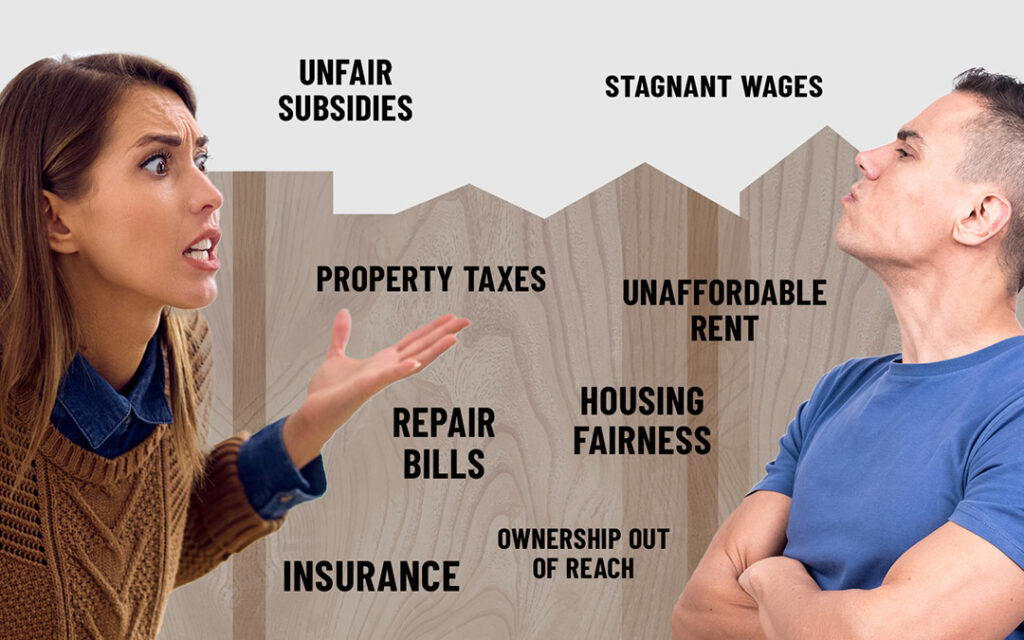
Second, rent control is counterproductive. As the Cato Institute explains, “The research near consistently finds that rent control leads to less mobility (not least, because people don’t want to give up their rent-controlled properties), more people living in properties unsuited to their needs, and higher rents for uncontrolled units. The vast majority of studies examining each find that rent control leads to a lower supply of rental accommodation, less new rental housing construction, and a fall in the quality of rental housing too.”
Third, while rent control limits what property owners can take in, it does not limit what goes out. Increases for property taxes, repairs, utilities, and property insurance must be absorbed by the landlord. The result is that rent control makes real estate investing less attractive and ultimately reduces the supply of rental units as they are sold off or converted to other uses. “While rent control appears to help current tenants in the short run,” explained the Brookings Institution in 2018, “in the long run it decreases affordability, fuels gentrification, and creates negative spillovers on the surrounding neighborhood.”
The Pros: The Case for Rent Control
First, rent control is needed because market rents are outpacing wages. In May, Zillow reported that “Since April 2020, rent for a typical U.S. apartment has increased by 28.7%, to $1,858, while rent for a single-family home increased by 42.9%, to $2,256. Over that time, the median household income has only risen by 22.5% to about $82,000 — showing that wages have not kept up with rents.”
Second, large rent increases play havoc with tenant budgets, especially households with fixed or low incomes. Baselane, a financial technology company, reports that “rent increases were widespread in 2024, with 85% of landlords raising rents and 31% implementing increases of 6-10%. Landlords also revealed that 78% plan to increase rents in 2025 by a weighted average of 6.21%.”
Third, tenants are falling behind. If they can’t buy a home, and they can’t rent, where do they live? Rent control holds down housing costs and makes housing affordable for many tenants. According to the National Equity Atlas, “Since 2000, the share of renters who are rent burdened has increased from 40 percent to 50 percent in 2022. The share of renters who are severely burdened increased from 1 in 5 to 1 in 4.”
Rent Control at the Ballot Box
New York politician Jimmy McMillan got a lot of attention when he ran for the state governorship in 2010. Powered by the catchy slogan, “the rent is too damn high,” McMillan’s campaign was based on the idea that tenants vastly outnumber landlords, have potent power at the polls, and largely favor rent control. And yet, in the end, he lost.
More recently, in a 2024 survey taken just before the elections, Redfin found that 82% of those surveyed agree that rent caps are okay, including 78% in California. And yet, a few days later, 60% of the electorate voted against California’s Proposition 33, a proposal to toughen local rent control regulations.
In New Jersey, Hoboken voters were asked last year to approve a proposal that would have allowed landlords to avoid rent control caps by paying $2,500 into an Affordable Housing Trust Fund. The proposal was shot down when 73% of the electorate voted against it, meaning that property owners would not be able to avoid rent control caps.
In the end, regardless of election results, government policies, or court decisions, rent control will remain a contentious subject, regardless of which side has the upper hand at the moment. That’s because by their nature, landlords and tenants have competing interests, something that will never change.