

This was supposed to be the year of the real estate pivot, a time when home sales surged and interest rates fell. Such things didn’t happen, so what can the industry do to build out a stronger real estate marketplace?
It used to be that solid sales were a reasonable expectation. Between 2016 and 2022, annual existing home sales were always above five million units. However, since 2023 such sales have fallen into the four-million range annually, according to the National Association of Realtors (NAR).
What we have today is not a real estate crash or anything close; instead, the culprit is strained affordability, a situation where ongoing demand has been offset by rising costs.
Qualification Creep
Over time we have seen qualification creep, the ability of borrowers to get bigger and bigger mortgages relative to their income. For instance, in FY2025 more than 30% of FHA borrowers had debt-to-income ratios (DTIs) above 50%, five times more than in FY2005.
Higher DTIs mean more risk, something not good for borrowers or lenders. In the second quarter, according to the Mortgage Bankers Association, the seasonally adjusted delinquency rate for FHA loans was more than four times greater than the rate for conventional loans.
Affordability concerns are not just limited to real estate costs. Non-housing debt has grown by more than a trillion dollars since 2019. Household budgets are often squeezed, and the result is that new financial products and standards have become widely available.
- Buy Now, Pay Later (BNPL) transactions allow users to make smaller purchases with four equal payments, maybe a $75 item or the week’s groceries. Such financing was up more than 90% between 2021 and 2022, according to the Consumer Financial Protection Bureau (CFPB).
- Payroll Advance Plans (Earned Wage Access, or EWAs) permit workers to access wages two days ahead of schedule. The CFPB reported in 2022 that the five leading EWA firms “originated 180 million loans totaling over $24 billion in 2021, a near tenfold increase from 2019.”
- Auto loans have evolved as new car prices have increased. Edmunds points out that in the second quarter almost 24% of all new car loans were for 84 months or longer (a record), the average new car loan was for $44,156 (the all-time high), the typical monthly payment was $777 (another record), and 20.3% of all new car borrowers were paying at least $1,000 a month (yup, a record).
These different ways of stretching credit are increasingly necessary as costs have climbed due to such factors as inflation, rising gas prices, and steeper food bills. In turn, household financing patterns are also in flux.
As the Wage to Wallet Index explains, “financial fragility runs deep, as low savings, high credit use and rising costs strain resilience. Workers are trading down and cutting back, with unstable income amplifying the pressure. Instant pay access emerges as a vital lifeline – most choose it when available, valuing the stability and relief it brings between pay cycles.”
Tight credit is not just an issue for the poor and middle class. Even those with significant incomes are watching their wallets.
“Six figures is survival, not success,” explained the 2025 Income Paradox Study from the Harris Poll. “Sixty-four percent of six-figure earners say six figures is no longer a sign of wealth but survival mode – a paycheck that covers costs, not comfort. The benchmark of success has become the bare minimum to keep up.”
Meanwhile, homeowners have been largely unscathed. Figures from ATTOM recorded an increase in foreclosure filings during the first half of the year, the formal paperwork sent to delinquent mortgage borrowers. However, while there were 227,548 filings, only 27,983 homes were actually foreclosed, according to ATTOM.
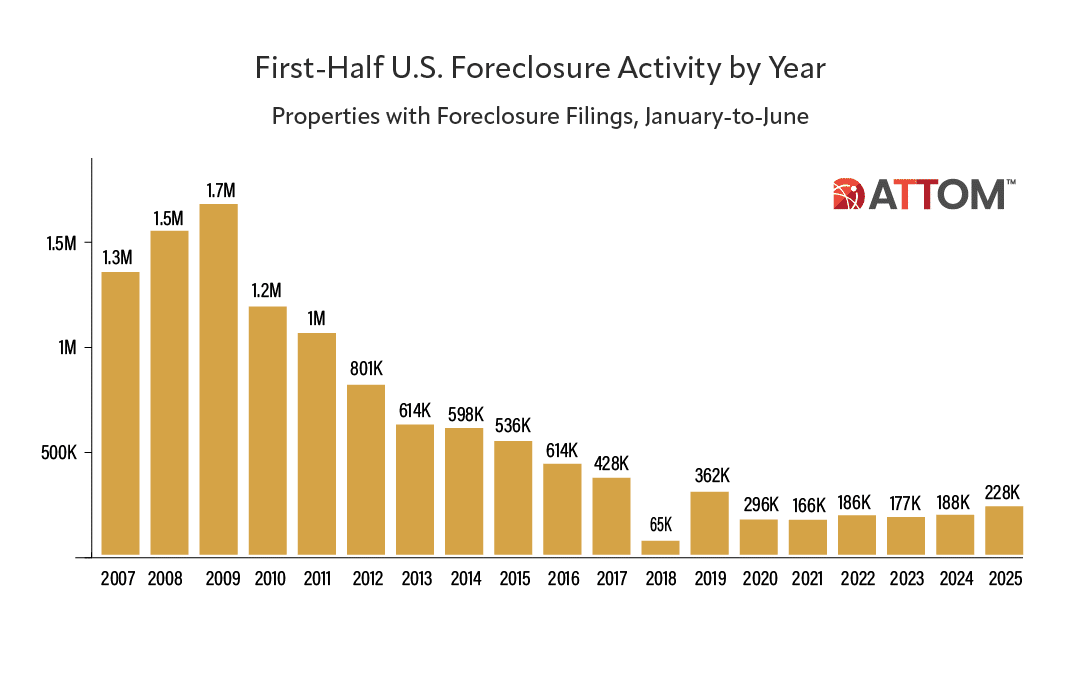
Given that there are approximately 87 million private homes in the US, why so few foreclosures?
First, there are 35 million mortgage-free homes, properties with no monthly costs for mortgage financing.
Second, savvy borrowers who run into financial problems are calling lenders, trying to save their properties. Given the costs and headaches created by foreclosures, lenders may be open to forbearance (short-term accommodations), repayment plans (allowing borrowers to make up missing payments over time), loan modifications (changing mortgage terms), and short-sales (allowing the property to be sold without fully repaying the debt).
Third, troubled borrowers may be able to quickly sell the property. Given the massive equity increases in recent years, sales can often pay off the mortgage in full, give sellers a substantial check at closing, and avoid foreclosure.
What Happened to the 2026 Real Estate Market?
There was a lot of real estate optimism in the air last year. Many thought the Fed would lower the federal funds rate in 2026, while NAR predicted a 14% sales surge.
However, as of late summer, the federal funds rate remained unchanged for the year. The interest rate for 30-year mortgages stood at 5.98% in late February but then increased to 6.67% in mid-August, according to Freddie Mac. The result was that Fannie Mae’s Purchase Application-Level Index (PALI) as of early August was down 5.8% when compared with a year earlier.
NAR reported at midyear that 2026 home prices, unit sales, and inventories were all up. Still, sales for the year appear likely to be around the four million mark, close to what we’ve seen since 2023.
The real estate market was surely not helped by mortgage rates that rose when many expected them to fall. Higher rates mean larger monthly principal and interest costs, and for many potential purchasers there just isn’t enough credit to take on mortgage debt after auto payments, student loans, credit card costs, and other expenses. Credit reporting agencies have increasingly begun to include BNPL transactions, while data from payroll advance programs are generally not shared with credit bureaus.
Despite affordability issues, in the first half of the year there was enough demand so that home values largely went up. An NAR study found that second-quarter home prices rose in 80% of the 235 metro areas it surveyed. Across the country, NAR estimated that prices increased 1.5%. That’s up, but it’s also less than the 3.5% rate of inflation.
In reality, the averages don’t work in many areas. Zillow reported in mid-summer that the “number of cities where a typical starter home is worth $1 million or more has nearly tripled since before the pandemic, rising from 80 in February 2020 to a record 242 today.”
If you have a typical household income – $83,730 in 2025 – a million-dollar starter home is beyond unaffordable.
What, then, can be done to increase home sales and thus brokerage activity and lender originations? Several strategies are emerging.
Mortgage Rates
If mortgage rates were to fall then we might reasonably expect the pool of potential buyers to grow. With more purchasers, competition for properties would increase, and we could see firmer prices in many local markets.
However, while there were forecasts of mortgage rate reductions late last year, the market view has changed. In mid-August, the CME FedWatch showed that 56.1% of polled interest-rate traders thought the federal funds rate in September would remain steady, 43.9% thought the Fed was likely to raise rates, and zero percent, none, believed the Fed would reduce rates. By January 2027, say the traders, 81.8% expect a Fed increase.
While the Fed does not set mortgage rates, it does influence financial markets. If the federal funds rate continues unchanged, or if there is an actual rate increase, then many potential buyers are likely to sit on the sidelines. Buyers in times with higher rates are likely to look for seller concessions, including outright price discounts. If this seems unlikely, consider that 20% of the metro areas tracked by NAR saw lower values as of the second quarter. That’s not nothing.
So, while help from the mortgage market seems unlikely for the rest of this year and into 2027, there are positive trends underway.
Modest Densification
We’re seeing homes in a new way, in large part because marketplace realities are evolving. Single-family zoning is being phased out. What used to be one home on one lot is increasingly one lot with two or more units.
In other words, to improve real estate economics we’re moving toward what the Housing Affordability Institute calls modest densification. We’re not only getting rid of single-family zoning standards, we’re also easing minimum home sizes and value requirements. The result is that in many areas we will have more people living on a block or in a community.
By the Numbers
Government figures show that privately-owned single-family housing starts in June were 30,000 units lower than a year ago. However, this is a case where we are undercounting residential units.
The federal government does not directly tally accessory dwelling units (ADUs) at this time. This may change with the 2030 census, as ADUs become more significant.
ADUs are separate living units with kitchen and bathroom facilities that are built into existing homes, perhaps in a garage, basement, or attic, or added as detached structures on existing lots. Each ADU can be considered the equivalent of an apartment or small home, adding to the housing stock without the need for new building lots or lengthy construction periods.
ADUs “allow homeowners to earn rental income to offset mortgage and maintenance costs, as well as empower them to make decisions about land they already own,” according to the Federal Housing Finance Agency (FHFA). It adds that “ADUs increase the housing stock without the need for new land, which can help promote the availability of affordable rental options.”
Looking at permit data, ATTOM estimates there are over 1 million ADUs nationwide. Additionally, there are an unknown number of unpermitted ADUs, a legacy of single-family zoning restrictions that banned such units. If you see an ad for something called an “English basement” or a “granny flat,” it might now be regarded as an ADU under new zoning standards.
The ADU movement will grow as legacy single-family zoning rules increasingly disappear. ADUs will offset the shortage of lower-cost rental units, allowing tenants to reduce monthly costs, bulk-up savings, reduce debt, and more readily qualify for a home purchase. Additionally, many ADU property owners will be able to get better prices when selling because monthly costs can be reduced with rental income from separate units.
The Future Is Smaller
Whether from new construction or additional ADUs, more housing units can lower rental rates. But another way to increase real estate affordability is to build smaller units.
Home sizes have expanded over time. When the Levittown planned community opened in 1947, its new homes averaged 750 sq. ft. By 2025, the typical new US home had 2,396 sq. ft.
“Each generation,” said the National Association of Home Builders in a 2025 report, “is progressively more open to having a smaller home with higher-quality products and amenities versus a larger home with fewer amenities. More than half of Gen Z (53%) and millennials (52%) are willing to make that compromise, with that percentage increasing to 61% for Gen X and 70% for boomers.”
Living rooms are shrinking with less formality. Separate dining rooms are being replaced with open spaces. Smaller families mean extra bedrooms can become offices, guest rooms, and gyms. And less size means there are fewer square feet to clean, heat, cool, and finance.
By getting rid of minimum size zoning requirements, we can build new homes with fewer square feet and substantial savings.
“Construction costs have climbed sharply over the past decade,” explains Indiana’s Value Built Homes. “Land prices, labor shortages, and material costs all contribute, and buyers feel every dollar. When each square foot costs more to build, extra square footage becomes a genuine financial decision rather than a default assumption.”
It adds that “the national move toward smaller, smarter floor plans reflects something buyers have known for a while: right-sized isn’t a compromise. It’s a strategy. A home that fits your life, your budget, and your long-term goals is a better investment than one that’s simply bigger.”
If it costs $200 to $250 per square foot for new construction, then reducing home sizes by 300 sq. ft. can produce purchase savings from $60,000 to $75,000. At 6.7% interest, such savings mean mortgage costs over 30 years will be reduced by roughly $387 to $484 per month. That’s a big advantage for many households seeking ownership. If financing is a hurdle for prospective buyers, then fewer zoning restrictions and smaller homes are workable ways to address the affordability problem.